 360° TOUR
 Student Interview|High Scores Are Never Accidental: Isabella’s English Progress Story
“
Progress does not happen overnight,
it depends on sustained practice,
and on finding enjoyment in the process.
“

At a sharing session in the Upper School at Harrow Beijing, Isabella Y, a Year 12 student (equivalent to Grade 11 in the public school system), told the story of her growth at Harrow Beijing in fluent and natural English.
She has currently achieved an excellent score of 8.5 in the IELTS examination. Today, let us take a closer look at this Harrow student who has grown from an “average student” into a confident speaker, and see how she has moved towards success step by step.
01
Harrow Beijing
Starting from an “average student”:
Six years of gradual progress
Isabella Y joined Harrow Beijing in 2019, when she was in Year 6 (equivalent to Grade 5 in the public school system). She frankly admits that when she first entered the school, she was only an “average-level” student, perhaps a little above the average line, but by no means one of the “top academic stars” in the class, and she was very clear about this herself.
Precisely because of this, she realised very early on that if she wanted to make a breakthrough in English, there was only one way forward—to take the initiative to change. Over the past six years, she has designed many small experiments for herself: proactively creating her own vocabulary lists and jotting down unfamiliar or interesting words; maintaining a steady habit of reading in English; taking part in different types of after-school activities; and joining the LAMDA public speaking programme.


All of these may not sound “dramatic”, and none of them could bring about an immediate, life-changing transformation, yet they quietly laid the foundation for the leap she would later make.
02
Harrow Beijing
Using English in real situations:
Key turning points on the pitch,
on the stage and in the classroom
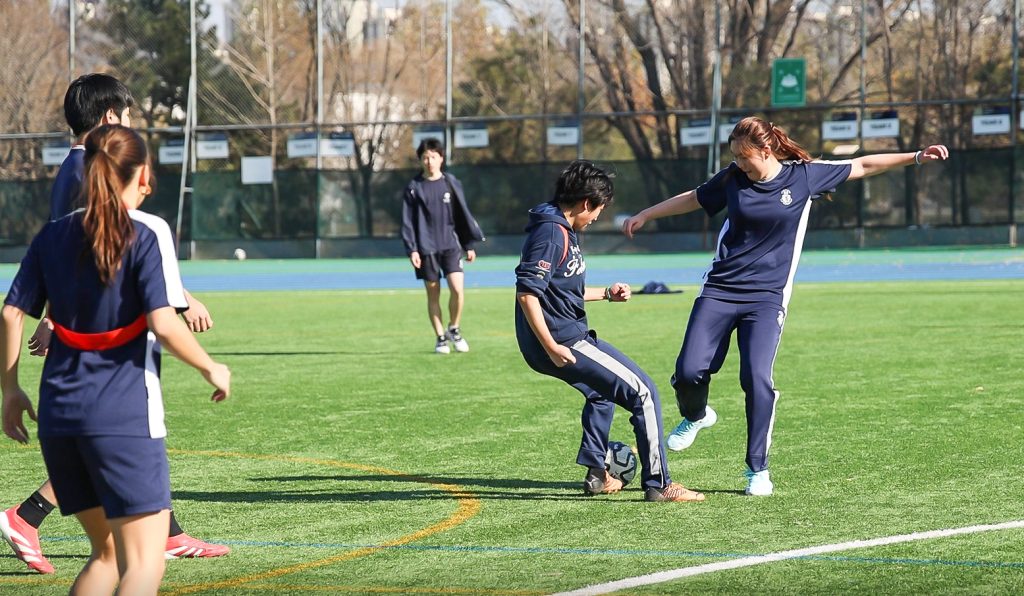
The first true turning point happened on the football field. In Year 6, Isabella joined an after-school football activity. Mr Chiron was not only the coach of this football activity but also her language learning teacher in Year 8, and he insisted on one rule during training: the whole team was required to communicate only in English on the pitch.
In such an environment, Isabella had no choice but to learn to use English to call for the ball, remind her teammates and explain tactics. At the same time, her teammates came from different countries, and to make sure that everyone could understand and cooperate, she had to speak with enough clarity and a sufficiently coherent line of reasoning. Over time, she found that what she cared about was no longer “whether this sentence is grammatically correct”, but “whether my teammates can immediately understand what I mean”. For her, in those moments English was no longer a set of rules in a notebook, but a real language that carried team collaboration.

Two years later, Isabella was still a member of the school football team, and at the same time she set herself another challenge: registering for the LAMDA public speaking examination. She eventually achieved the Gold Medal Grade 8 in LAMDA Public Speaking (the highest level in public speaking), but in her view, what was more valuable than the certificate itself was the training process. For each examination, she had to keep practising how to build the structure of a speech and how to express her ideas more clearly, and she also had to face the impromptu speaking component—delivering a one- to two-minute speech on a completely unfamiliar topic on the spot. She jokes that this challenge “is very similar to the IELTS speaking test, if not even more difficult”, and it is precisely this high-intensity training that has taught her to stay calm under pressure and to organise her language quickly.

After entering the IGCSE stage, she chose IGCSE History. Her history teacher guided her to look at the same matter from multiple perspectives. This subject made her realise that a good English essay is far more than a pile-up of vocabulary and grammar; what matters even more are its logical structure and line of argument. Later on, whether in everyday academic writing or in her IELTS writing tasks, she was able to apply the way of thinking she had developed in history lessons.
From the football pitch to the speaking stage and then to the academic classroom, these seemingly unrelated settings, when put together, form the key pathway in Isabella’s leap in language ability: daring to speak, being able to express herself, and having something to say.
03
Harrow Beijing
Small habits + home–school collaboration:
The long-term mindset behind an IELTS 8.5
Beyond these highlight moments, Isabella’s growth relies even more on the steady, everyday accumulation of effort, of which an important part is reading.
At the beginning, she read about three to four books a month, which might not seem like very many to others, but by the time she reached Year 11, the intense IGCSE preparation year, and the pressure of examinations had increased significantly, she was still managing to read four to five books every month. Her reading list covered everything from literary fiction to non-fiction and mystery thrillers; teachers would also recommend extended reading based on her subject choices—for example, The Periodic Table, recommended by Mr Aspin. These reading experiences quietly expanded her vocabulary and background knowledge and improved her ability to understand complex texts.
At the same time, she prepared a “personal vocabulary notebook” for herself, in which she recorded unfamiliar yet interesting words encountered in her reading or listening. Isabella admits that if she were asked to recite all of these words now, she might not be able to list them one by one, but it is precisely this long-term persistence, and the process of constantly building connections between new words, that has gradually given her a sense of familiarity with English so that she no longer feels intimidated when faced with complex texts.

As she entered the exam preparation stage, she began listening extensively to English podcasts and audiobooks, filling her fragmented time with English input. In her view, listening skills are often more difficult to improve than reading and writing, and it is this sustained listening input that has strongly supported her high score in IELTS listening.
If Isabella’s personal effort constitutes the internal driving force of her growth, then the family atmosphere is the foundation that supports her journey. At home, her mother reads with her and discusses storylines; her younger brother chats with her in English; and her father practises English on an app every day—the whole family has already kept up a streak of more than 200 days. Many times, she explains questions to her father while at the same time consolidating her own expression, and this state of mutual encouragement and shared progress has turned English from “a language used only in class” into the everyday language of the whole family.
At the end of her sharing, Isabella wanted to say this to her younger schoolmates: progress does not happen overnight; it depends on consistent practice and on finding enjoyment in the process. If you can boldly use English in real situations, accumulate bit by bit in reading, listening and writing, and also have the companionship and support of teachers and family, then an IELTS 8.5, which may seem like a distant goal, will in the end become a natural outcome.

Join us to meet with academic staff, visit our outstanding facilities, interact with current pupils and individual consultation with our admissions team.